
"coffee globalization"
9000 article(s) found

Global coffee producing area-Cuba
According to records, there were 2067 coffee plantations in Cuba in 1833. Among them, the earliest seven coffee plantation sites, such as Raglan Piedra, Elkovre, El Salvador and Nisto Perez, are listed as World Cultural Heritage. These seven coffee plantations are located in the foothills of Maestra in the provinces of Santiago and Guantanamo in southeastern Cuba in the 19th century (figure 17 is a postcard).
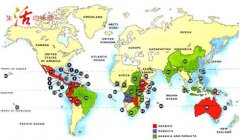
Map of global coffee producing area for the production of boutique coffee beans
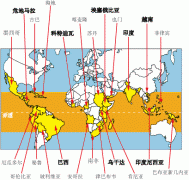
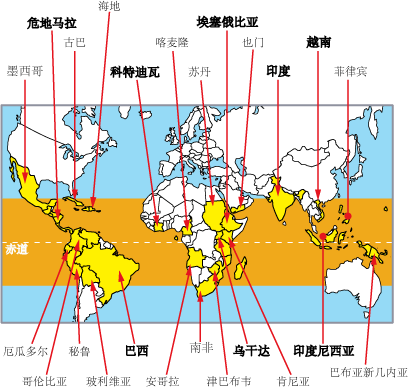
Coffee trees grow in tropical or subtropical agricultural gardens centered around the equator and called coffee belts. Most of the coffee production is between the Tropic of Cancer, 25 degrees north of the tropical or subtropical equator and 30 degrees south of the equator. An area with an annual average temperature of 16-25 degrees Celsius, no Frosts Descent and rainfall of 1600-2000 mm.

Global coffee producing area-Dominica
The Dominican Republic (DominicanRepublic) is adjacent to Haiti, and both own the island of Hispaniola (Hispaniola). In the early 18th century, coffee was grown in the Dominican Republic. Coffee production in the Dominican Republic: the best coffee producer in the Dominican Republic is the Barahona region in the southwest, but Juncalito
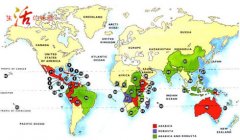
Analysis of global coffee producing area map analysis of coffee bean production area
Coffee trees grow in tropical or subtropical agricultural gardens centered around the equator and called coffee belts. Most of the coffee production is between the Tropic of Cancer, 25 degrees north of the tropical or subtropical equator and 30 degrees south of the equator. An area with an annual average temperature of 16-25 degrees Celsius, no Frosts Descent and rainfall of 1600-2000 mm.
Coffee producing area 53 global coffee producing area Dominica Dominica
Dominica's delicious, sweet, full-grained coffee the Dominican Republic (Dominican Republic) is next to Haiti, and both have the island of Hispaniola (Hispaniola). Like its neighbours, the Dominican Republic had a history of revolution and poverty, but now it has democratic elections and the country is relatively stable. In the early 18th century, coffee
Coffee producing area 53 global coffee producing area Dominica Dominica
Dominica's delicious, sweet, full-grained coffee the Dominican Republic (Dominican Republic) is next to Haiti, and both have the island of Hispaniola (Hispaniola). Like its neighbours, the Dominican Republic had a history of revolution and poverty, but now it has democratic elections and the country is relatively stable. In the early 18th century, coffee

The global ranking of coffee is second only to tea.
The reason for the coffee consumption craze

Basic knowledge of Coffee training Global Coffee producing area Map
Coffee trees grow in tropical or subtropical agricultural gardens centered around the equator and called coffee belts. Most of the coffee production is between the Tropic of Cancer, 25 degrees north of the tropical or subtropical equator and 30 degrees south of the equator. An area with an annual average temperature of 16-25 degrees Celsius, no Frosts Descent and rainfall of 1600-2000 mm.

A global coffee producer in the Democratic Republic of Sao Tome and Principe.
In 1800, the Democratic Republic of Sao Tome and Principe (SaoTomeandPrincipe) introduced Arabian coffee trees from Brazil. The Democratic Republic of Sao Tome and Principe (SaoTomeandPrincipe), the second smallest independent country in Africa, was once a Portuguese colony and did not win its independence until 1975. Coffee production in the Democratic Republic of Sao Tome and Principe: Sao Tome and Principe

Global Coffee Origin-Sao Tome and Principe
In 1800, the Democratic Republic of Sao Tome and Principe introduced Arabica coffee trees from Brazil. Sao Tome and Principe, Africa's second smallest independent state, was a Portuguese colony until 1975, when it won independence. Sao Tome and Principe Democratic Republic Coffee Origin: Sao Tome and Principe

Global coffee producing area-Australia
Coffee trees began to be planted in Queens land, Australia (Australia) in 1896. Australia is an amazing country in many ways. The high-quality coffee grown here is perhaps one of the most amazing things. The characteristics of Australian coffee: Australian coffee is of high quality and has a soft taste with a slightly bitter taste of caffeine.
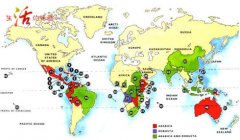
Global Coffee producing countries take a large inventory of where coffee is produced? Each
Coffee trees grow in tropical or subtropical agricultural gardens centered around the equator and called coffee belts. Most of the coffee production is between the Tropic of Cancer, 25 degrees north of the tropical or subtropical equator and 30 degrees south of the equator. An area with an annual average temperature of 16-25 degrees Celsius, no Frosts Descent and rainfall of 1600-2000 mm.

Mexico ranks sixth in global coffee production
Mexico already has an annual output of 4.5 million bags, ranking sixth in the world, after Brazil, Vietnam, Indonesia, India and Colombia.
Global coffee producing area map coffee bean producing area
1. Costa Rica Costa Rica 2. Cuba Cuba 3. Dominican Republic Dominican Republic 4. Ei Salvador El Salvador 5. Guadeloupe Guadeloupe 6. Guatemala Guatemala 7. Haiti Haiti 8. Honduras Honduras 9. Jamaica Jamaica 10. Martinique Martinique 11. Mexico Mosi

The fourth order strategy of 2017 global cafes
Spanish Barcelona Coffee beans: Mezcla Features: the taste of Spanish coffee seems to be as agreeable as the happy character of Spaniards. The unique torrefacto roasting technology here retains the sweetness of coffee beans and makes everything just right. Order strategy: Caf solo very strong, bitter espresso Caf bombn Caf solo with high sweetness concentrated milk

Global Coffee producing area in Panama
Coffee was first grown in America around the 1820s. Today, coffee farming occupies an extremely important economic position in Panama. The Republic of Panama was founded on November 3, 1903. The nearly century-old coffee factory is located in a charming dense rainforest valley. Panama Coffee: Panamanian Coffee Coffee is grown in the western part of the country, near
Costa Rica, the global coffee producer
Tarrazu of Costa Rica, a global coffee producer, is one of the major coffee producers in the world. The coffee produced is light and pure in flavor and pleasant in aroma. Costa Rica, with its fertile volcanic soil and good drainage, is the first country in Central America to grow coffee and bananas for commercial value. Coffee and bananas are the country's main exports. one hundred and seventy two

Global Cat Coffee trend from Taiwan to the World
Taiwan has led to a global upsurge of cat coffee. San Diego in the United States and Vancouver in Canada will open cat coffee shops one after another to provide new leisure places for cat lovers.

Global Coffee producing area-El Salvador Coffee Market
ElSalvador is one of the small countries in Central America with a dense population. The flavor of its coffee is characterized by excellent balance. Coffee production in El Salvador: like Guatemala and Costa Rica, coffee in El Salvador is graded according to altitude, and the higher the altitude, the better the coffee. The best brand is Pipil, which is the Aztec Mayan (A
The sixth order strategy of 2017 global cafes
German Berlin Coffee beans: Arabic Coffee beans characteristics: compared with several coffee beans listed above, Arabic coffee beans are roasted more lightly. In order to make delicious coffee, these beans need to be ground very carefully to ensure that each particle is in contact with hot water to maximize the aroma of the coffee. Order introduction: Milchkaffee: large black coffee with steam